Search This Blog

Wednesday, September 13, 2023

There Will Be Blood


Genre: pioneer drama

With: Daniel Day-Lewis (Daniel Plainview), Paul Dano (Eli and Paul Sunday), Dillon Freasier and Russell Harvard (Daniel's son, H.W., as a child and an adult), Kevin O'Connor (Henry), David Willis (Abel Sunday, the father), Christine Olejniczak (Mother Sunday), James Downey (Al Rose, Daniel’s assistant), Ciaran Hinds (Hamilton Fletcher), Vince Froio (Daniel’s servant), Hans Howes (Bandy), David Warshofsky (H.M. Tilford, from Standard Oil)

Director: Paul Thomas Anderson

Screenplay: Paul Thomas Anderson (based on Upton Sinclair’s novel ‟Oil!”)

Release: 2007

Studio: Paramount Vantage, Miramax

Rating: R

MBiS score: 8.6/10


The Creed of Greed 


QuickView

Story-line: when he began prospecting circa 1898, Daniel Plainview worked relentlessly, risking his neck (and other men's lives) to hit a motherlode or strike a gusher. A decade or so later, we find him a craftier man still determined to hit pay dirt… and as he listens to Paul Sunday’s description of a property out west that oozes oil like a wet sponge, he can feel it in his bones: there’s wealth out there to be pumped from the ground.      

Pluses: outstanding acting by Daniel Day-Lewis (a soft-spoken but calculating Plainview) and Paul Dano (very convincing as the Sunday brothers), excellent direction, a vigorous and realistic screenplay full of atmosphere and dust, discoloured cinematography that enriches the narrative with its striking recreation of the early 1900s, well-conceived production values (notably costumes), Jonny Greenwood’s nightmarish musical score and an unpredictable ending that you may find tragic, funny... or both.

Minuses: none I can think of.

Comments: ablaze with entrepreneurial spirit, rampant ambition and religious fervour, THERE WILL BE BLOOD is a different, captivating work about oil, dealmaking, family issues and plain greed. Inspired by Upton Sinclair’s brilliant story, Paul Thomas Anderson has fashioned an impressive work for all to see, one more in his fine career as a director.  


MBiS 

© 2023 – All rights reserved

Little Women


Genre: historical coming-of-age drama

With: Winona Ryder (Josephine ‟Jo” March), Trini Alvarado (Margaret ‟Meg” March), Samantha Mathis (Older Amy), Kirsten Dunst (Younger Amy), Claire Danes (Beth March), Christian Bale (Theodore ‟Laurie” Laurence), Eric Stoltz (John Brooke), John Neville (Mr. Laurence), Susan Sarandon (Mrs. Abigail ‟Marmee” March), Florence Paterson (Hannah), Gabriel Byrne (Friedrich Bhaer)

Director: Gillian Armstrong

Screenplay: Robin Swicord (based on Louisa May Alcott's novel)

Release: 1994

Studio: DiNovi Pictures, Columbia Pictures Corporation

Rating: PG

MBiS score: 8.1/10


‟I am longing for transformation.”


QuickView

Story-line: Concord (Mass.) during the Civil War. Jo, a budding writer and the most spirited of the four March sisters, recounts the problems faced by her family while their father was serving in the army.

Pluses: an evenly competent cast led by Winona Ryder (as the direct, enterprising Jo), Kirsten Dunst (the rascally Amy), Christian Bale, Trini Alvarado, Claire Danes and Gabriel Byrne, adroit direction, a clean, sturdy and disciplined screenplay featuring juicy dialogues and highlighting the different personalities of the March girls, polished cinematography, irreproachable production values and a touching musical score by Thomas Newman.

Minuses: after a cutesy, distant and anecdotal first half that belies the family’s predicament (and the risks incurred by the father at war), the film picks up the slack with a noble and more dramatic second half. 

Comments: at this point in movie history, it must be a special challenge to tackle LITTLE WOMEN, considering the novel’s hallowed place in American literature and the number of filmed versions Hollywood has produced (this was the third, after those in 1933 and 1949, with the most recent in 2019). And the challenge was met handsomely by Gillian Armstrong and a lovely group of young actresses who went on to greater things after their portrayal of the March sisters. On a moral level, I’ll give credit to LITTLE WOMEN for its wholesomeness, social conscience and strong insights about life’s pivotal moments. Variety, they say, is the spice of life… and movie buffs won’t regret seeing this kind of heartfelt cinema.      


MBiS

© 2023 – All rights reserved

Friday, August 4, 2023

His Girl Friday


Genre: comedy (in black and white)

With: Cary Grant (Walter Burns), Rosalind Russell (Hildy Johnson), Ralph Bellamy (Bruce Baldwin), Gene Lockhart (Sheriff Hartwell), Porter Hall (Murphy), Ernest Truex (Bensinger), Cliff Edwards (Endicott), Clarence Kolb (Mayor), Roscoe Karns (McCue)

Director: Howard Hawks

Screenplay: Charles Lederer, Ben Hecht and Morrie Ryskind, from the play by Ben Hecht and Charles MacArthur

Release: 1940

Studio: Columbia Pictures Corporation

Rating: -

MBiS score: 8.6/10 


When Edward R. Murrow Said That ‟We cannot make good news out of bad practice”, He Had Obviously Never Met Walter Burns


QuickView

Story-line: Walter Burns, the editor of the Morning Post, cannot accept that his ace reporter and ex-wife Hildy Johnson is quitting for good and marrying an insurance salesman from Albany. He has a huge news story to break and he needs all of Hildy’s talent and moxie to do it. 

Pluses: amazing acting by Cary Grant and a remarkably feisty Rosalind Russell, excellent support from a fine cast, a very strong and lively screenplay that develops brilliant comic situations with the aid of warp-speed dialogues, unbridled humour, appreciable wit and occasional cruelty, Howard Hawks’ vigorous direction, eye-pleasing cinematography by Joseph Walker and fine production values.

Minuses: none, except that this movie’s relentless pace may drain you.   

Comments: HIS GIRL FRIDAY throws everything into the pot – Hildy’s dedication, Walter’s conniving ways, crooked politicians, underhanded dealings, matters of love and crises of conscience – to serve up a comedy stew that will please everyone at the table. Without a doubt, this old and boisterous movie is still one of the most effective and intelligent comedies ever captured on film.


MBiS 

© 2023 – All rights reserved

Das letzte Mahl 


English title: Last Supper (The)

Genre: social, psychological and political drama

With: Bruno Eyron (Aaron Glickstein), Sharon Brauner (his wife Rebekka), Michael Degen and Daphna Rosenthal (Aaron’s father, Jacob, and his wife Ruth), Mira Elisa Goeres and Patrick Mölleken (Leah and Michael, Aaron’s daughter and son), Bela B (Rabbi Benjamin Aschkenasi), Sandra von Ruffin (Sarah, Aaron’s sister), Adrian Topol and Judith Hoersch (Daniel, Aaron’s brother, and his wife Monika), Charles Brauer (Max Liebermann), Werner Daehn (Siegmund Loewe)

Director: Florian Frerichs

Screenplay: Florian Frerichs and Stephan Warnatsch

Release: 2018

Studio: Menemsha Films, Warnuts Entertainment, Ventaro Media, Frame 12

Rating: -

MBiS score: 8.4/10 


‟I am German first, and a Jew second.” 


QuickView

Story-line: Berlin, January 30, 1933. At the Salon Olympia, Jewish businessman Aaron Glickstein meets Liebermann, an old friend, and invites him to a birthday dinner honouring his father Jacob. Liebermann doesn’t commit… and will look all the wiser for it. That evening, Aaron’s business dealings, conflicts among relatives and current events in Germany (Hitler’s appointment as chancellor) will cast a pall over what was supposed to be a festive occasion for the Glicksteins.

Pluses: credible and involved acting by the whole cast − led by Bruno Eyron as the flawed but respectable Aaron −, smooth direction, an astute and urgent screenplay rich in interplay, character development and intelligent dialogues, elegant production values, polished cinematography, a tasteful musical score and a thought-provoking denouement.

Minuses: at first blush, the film’s premise may seem artificial… but this is clearly a case where first impressions don’t count.

Comments: THE LAST SUPPER − which recalls one critical day for the Glicksteins and takes place mostly in the family home − has a patently theatrical feel because of its staging, emphasis on dialogues and existential subject matter (the quest for one’s identity). Every character seated at the table has something important to say… and Aaron, to his own astonishment, suddenly discovers that the world has changed behind his back. If this modest movie doesn’t show much in the way of ‟action”, it sets up a robust clash of personalities and ideas that makes it an excellent choice for movie buffs. 


MBiS 

© 2023 – All rights reserved

Friday, July 14, 2023

Capharnaüm


Also known as: Capernaum, Chaos

Genre: social drama  

With: Zain Al Rafeea (Zain Al Hajj), Yordanos Shiferaw (Rahil, a.k.a. Tigest), Boluwatife Treasure Bankole (Yonas, Rahil’s baby), Kawsar Al Haddad (Souad Al Hajj, Zain’s father), Fadi Yousef (Selim, Zain’s mother), Cedra Izzam (Sahar, Zain’s sister), Alaa Chouchnieh (Aspro the wheeler-dealer), Elias Khoury (the Judge), Nour El Husseini (Assaad the grocer), Tamer Ibrahim (Abou Assaad, the grocer’s father)

Director: Nadine Labaki

Screenplay: Nadine Labaki, Jihad Hojeily, Michelle Keserwany

Release: 2018

Studio: Mooz Films, Doha Film Institute, KNM Films, Boo Pictures, Synchronicity Films et al.

Rating: R

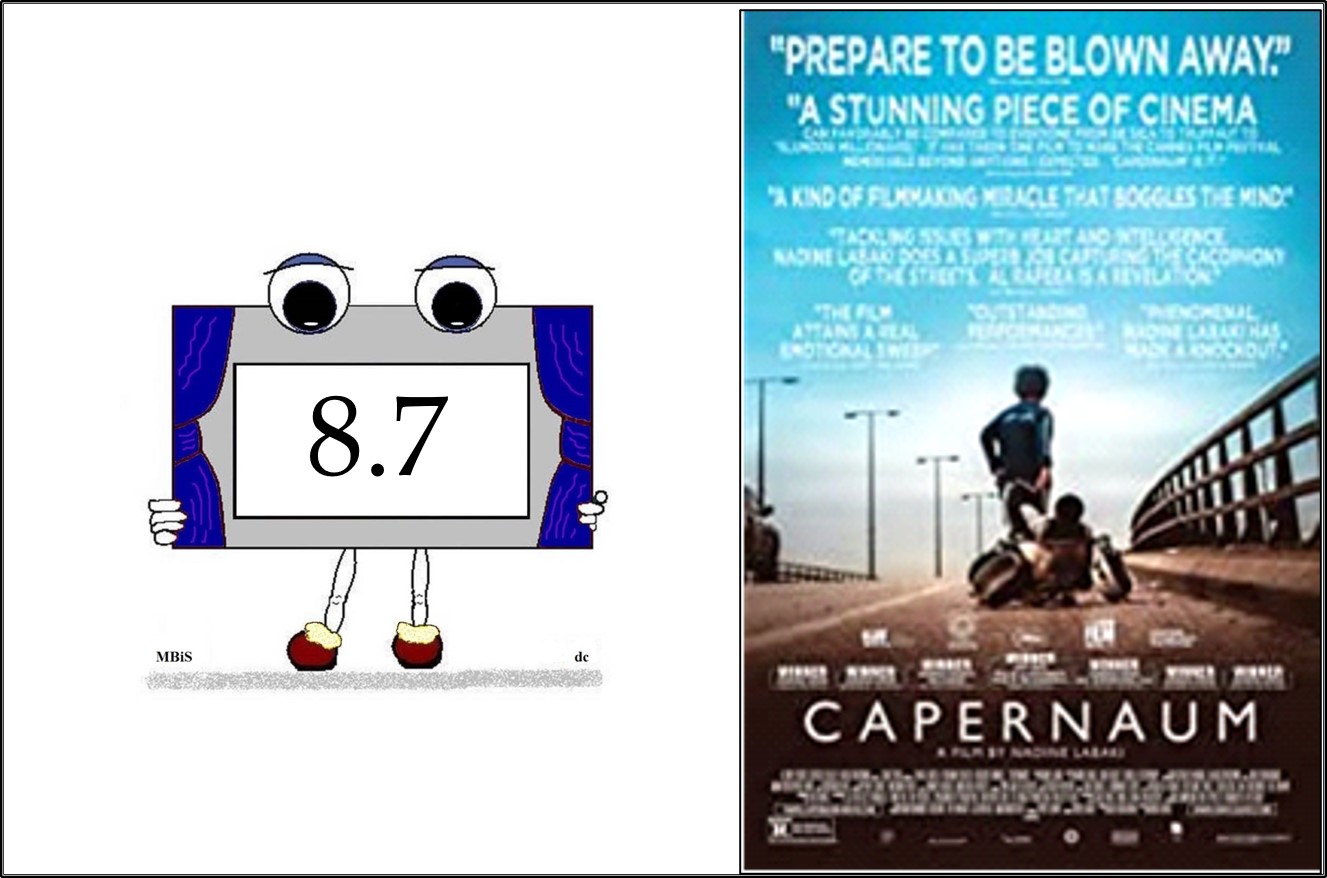
MBiS score: 8.7/10 


Delinquent with a Cause 


QuickView

Story-line: a 12-year-old Lebanese boy convicted of attempted murder forces his parents to appear in court so he can settle accounts with them.

Pluses: outstanding acting by Zain Al Rafeea (as the streetwise and resourceful Zain), Cedra Izzam (his loving sister), Boluwatife Treasure Bankole (adorable in a prominent role) and a strong cast of grown-ups, remarkable direction by an important Lebanese helmer, a restless, forceful and far-reaching screenplay that raises issues of parental neglect, poverty and survival, Christopher Aoun’s startlingly informative camera work, irreproachable production values and a beautiful, tormented musical score by Khaled Mouzanar.

Minuses: this movie is quite bleak… but so involving that you will drink in everything on screen. The comments on the movie poster above are all true.

Comments: it took me four minutes − those bracing scenes of Zain and immigrant women at the police station and that spectacular drone shot of kids running in the streets of a Lebanese city to realize why the tragic and utterly pathetic CAPHARNAÜM garnered the Prix du jury at the Cannes Film Festival. In its careful recounting of Zain’s childhood and tribulations in a careless world, it balances misery, lawlessness and exploitation with nobility and courage in a believable and visually breathtaking way. Nadine Labaki, always a fine director, can be especially proud of this accomplished motion picture, one of the many gems produced by contemporary international cinema. Bravo Nadine! 


MBiS 

© 2023 – All rights reserved

Dimanches de Ville d’Avray (les)


English title: Sundays and Cybèle

Also known as: Cybèle ou les Dimanches de Ville d’Avray

Genre: psychological drama (in black and white)

With: Hardy Krüger (Pierre), Patricia Gozzi (Cybèle/Françoise), Nicole Courcel (Madeleine), Daniel Ivernel (Carlos), André Oumansky (Bernard)

Director: Serge Bourguignon

Screenplay: Serge Bourguignon and Antoine Tudal (based on a novel by Bernard Eschassériaux); dialogues by Serge Bourguignon and Bernard Eschassériaux

Release: 1962

Studio: Fidès, Les Films Trocadero, Orsay Films, Terra Film Produktion

Rating: for all

MBiS score: 8.6/10 


Appearances Can Be Deceptive


QuickView

Story-line: a retired military pilot, still tormented by the death of a child during a bombing run two years earlier in French Indochina, finds solace when he meets a little girl who has come to Ville d'Avray for schooling.  

Pluses: great performances by Hardy Krüger and Nicole Courcel as the adult protagonists and young Patricia Gozzi as the utterly believable Cybèle, a well-developed and finely observed screenplay, excellent direction and production values, superb photography by Henri Decaë and a suitable musical score by the renowned Maurice Jarre.

Minuses: none whatsoever. This film didn't inspire me much when I read its brief synopsis in a movie guide but, once I got into it, I was astounded by its human interest, dark undertones and artistic merit.  

Comments: LES DIMANCHES DE VILLE D'AVRAY, a universal fable about friendship, people's needs and the struggles of life, reminded me of two classic novels, Antoine de Saint-Exupéry's beloved The Little Prince (for its powerful symbolism) and John Steinbeck's Of Mice and Men (for its treatment of an ambiguous and morally delicate situation). This perfect movie garnered the Foreign Film Oscar in 1963. For good reason, I might add.


MBiS 

© 2023 – All rights reserved

Monday, June 12, 2023

La battaglia di Algeri


English title: Battle of Algiers (the)

Also known as: Bataille d’Alger (la)

Genre: political drama (in black and white)

With: Brahim Hadjadj (Ali la Pointe, FLN operative), Jean Martin (Lt. Col. Mathieu), Yacef Saadi (Djafar, FLN organizer), Samia Kerbash (Fathia), Tommaso Neri (Captain), Ugo Paletti (Captain), Fusia El Kader (Halima), Mohamed Ben Kassen (Petit Omar, Ali’s son), Mohammed Beghdadi (Ben M’hidi)

Director: Gillo Pontecorvo

Screenplay: Franco Solinas (from a story by Franco Solinas and Gillo Pontecorvo)

Release: 1966

Studio: Igor Film, Casbah Film

Rating: -

MBiS score: 8.9/10 


Freedom the Hard Way 


QuickView

Story-line: in 1957, the capital of Algeria is a city of contrasts. Its European district is modern and rich while the casbah, home to the Muslim majority, is cramped and poor. With growing insistence, Algerians call for their independence from France and some of them – notably the Front de libération nationale – see violence as the only way to achieve it. For their part, French authorities use every means available to maintain their grip on what they consider their rightful colony. The stage is set for a long, fierce and tragic confrontation. 

Pluses: intense acting by Brahim Hadjadj and a great cast, awe-inspiring direction (particularly in the vivid crowd scenes), a brilliant and magnificently structured screenplay that documents its subject systematically through non-stop action and chilling dialogues, amazing cinematography and visuals, a heart-pumping musical score and a potent ending.

Minuses: I had heard that THE BATTLE OF ALGIERS was a great film but it’s only recently that I had a chance to see it. If such an opportunity comes your way, don’t let it slip by...

Comments: this monumental picture and deserving Golden Lion winner explores both sides of the issue unflinchingly and doesn’t hide the ruthlessness shown by Algerian and French forces through guerrilla warfare, propaganda, harassment, mass punishment, acts of terror and use of informants. While weaving its devastating narrative, THE BATTLE OF ALGIERS depicts an important world event that is still felt today in the uncomfortable relationship between France and its former colony. As a matter of history, it is estimated that the conflict cost somewhere between 500,000 and 1 million lives, mostly on the Algerian side. For this alone, Gillo Pontecorvo’s work is an essential contribution to international cinema. Its awesome power will leave you speechless and numb.   


MBiS 

© 2023 – All rights reserved

Deux jours, une nuit


Genre: workplace drama

With: Marion Cotillard (Sandra), Fabrizio Rongione (Manu), Catherine Salée (Juliette), Baptiste Sornin (Mr. Dumont), Pily Groyne (Estelle), Simon Caudry (Maxime), Alain Eloy (Willy), Lara Persain (Willy’s wife), Myriem Akheddiou (Mireille), Fabienne Sciascia (Nadine), Olivier Gourmet (Jean-Marc), Timur Magomedgadzhiev (Timur)

Directors: Jean-Pierre and Luc Dardenne

Screenplay: Jean-Pierre and Luc Dardenne

Release: 2014

Studio: Les Films du Fleuve, Archipel 35, BIM Distribuzione et al.

Rating: PG

MBiS score: 8.5/10 


‟I don't exist. I'm nothing. Nothing at all!” 


QuickView

Story-line: as she gets ready to resume work after a lengthy illness, Sandra learns that a vote has been held among her colleagues and that, given a choice between taking her back or receiving a €1000 bonus each to cover her workload, they have voted for the bonus. Undeterred by what she sees as an injustice, Sandra asks for a second vote.

Pluses: a dominant, emotionally-charged performance by Marion Cotillard, natural and measured acting by an able cast (Fabrizio Rongione, Olivier Gourmet and Timur Magomedgadzhiev are especially convincing), efficient, high-quality direction, a tight, no-frills screenplay that focuses on what’s essential and conveys crucial psychological insights, on-point dialogues, basic but eloquent cinematography, well-suited production values and a strong denouement.

Minuses: none, except for Sandra’s annoying cellphone ring (you’ll hear it often).

Comments: for some reason, I have trouble recognizing Marion Cotillard from one movie to the next – which may partly explain her status as one of France’s brightest, most versatile stars – and her performance here adds to her already fine resumé. DEUX JOURS, UNE NUIT is another low-budget marvel from the Dardenne brothers, a thoughtful and utilitarian tale about lives in jeopardy, self-interest, decency and workplace politics. This is the kind of cinema I appreciate: no superheroes, no far-flung story-lines… but real people dealing with real problems. Vital moviemaking at its best. 


MBiS 

© 2023 – All rights reserved

Thursday, May 11, 2023

Lawrence of Arabia


Genre: adventure and war drama

With: Peter O Toole (T.E. Lawrence), Alec Guinness (Prince Faisal), Omar Sharif (Sherif Ali Ibn El Kharish), Anthony Quinn (Auda Abu Tayi), Jack Hawkins (General Allenby), José Ferrer (the Turkish Bey), Anthony Quayle (Colonel Brighton), Claude Rains (Mr. Dryden), Arthur Kennedy (Jackson Bentley), Donald Wolfit (General Murray), I.S. Johar (Gasim), John Dimech (Daud), Michel Ray (Farraj)

Director: David Lean

Screenplay: Robert Bolt and Michael Wilson

Release: 1962

Studio: Horizon Pictures, Sony Pictures Releasing International

Rating: PG

MBiS score: 8.9/10 


– You figure that you will have a democracy and a parliament?

– I’ll tell you when we have a country. 


QuickView 

Story-line: Britain, 1935. While riding his motorcycle with abandon, T.E. Lawrence is forced off the road and meets an unhappy fate. As his life, his death draws mixed emotions. For some people, he was a figure from the past and nothing more, for one former acquaintance, a mere office clerk in Cairo, for another, ‟a poet, a philosopher, a mighty warrior… and the most shameless exhibitionist since Barnum and Bailey”. This movie tells the story of the ordinary map drawer who came to be known as ‟Lawrence of Arabia”.

Pluses: an awesome and intoxicating performance by Peter O’Toole (in one of his earlier movie roles), great acting by Omar Sharif (the strong and enigmatic Ali), Alec Guinness (Faisal, a very smooth operator), Anthony Quinn (the hilarious brute) and other well-known thespians, a vigorous screenplay that uses truthful dialogues and dry wit to weave scene after potent scene, magical direction by David Lean, Freddie Young’s breathtaking cinematography that glorifies the mighty desert, magnificent production values and a musical theme (by Maurice Jarre) loved the world over.

Minuses: the script contains several insulting remarks about Arabs − uttered mainly by diehard colonialists − but refutes them in an understated way. Viewers who shun violence should note that LAWRENCE OF ARABIA, although a war movie, doesn’t feature excessive bloodshed. Its only drawback would be its length if you have precious little time on your hands; in all other respects, this Best Movie Oscar winner for 1962 should be on any movie buff’s priority list.     

Comments: LAWRENCE OF ARABIA, a grand and perfect epic, is so different and fascinating that it doesn’t matter what judgment you pass on its main character. In my book, Lawrence was everything he was said to be an adventurer, a messianic figure, one of the builders of the Arab nation − and his legacy still reverberates today in history and international politics. Kudos to David Lean and crew for this supreme accomplishment in cinematic art.


MBiS 

© 2023 – All rights reserved

Maman et la putain (la)   


English title: The Mother and the Whore

Genre: romantic drama (in black and white)

With: Jean-Pierre Léaud (Alexandre), Bernadette Lafont (Marie), Françoise Lebrun (Veronika), Isabelle Weingarten (Gilberte), Jacques Renard (Alexandre's friend), Jean-Noël Picq (the Offenbach fan)

Director: Jean Eustache

Screenplay: Jean Eustache

Release: 1973

Studio: Élite Films, Ciné Qua Non,  Les Films du Losange et al.

Rating: -

MBiS score: 8.2/10 


Should You Look Before You Leap? 


QuickView 

Story-line: if Alexandre doesn't have a job, it's probably because he has too much to do already. He lives with Marie, still loves his former squeeze Gilberte, is heartbroken when he learns that Gilberte will marry a doctor but is already attracted to Veronika, a girl he saw sitting at a restaurant terrace. Sounds complicated? It is! 

Pluses: an intense performance by Jean-Pierre Léaud as the intellectual and insatiable Alexandre (his quasi theatrical soliloquies are mesmerizing), strong support from Bernadette Lafont and Françoise Lebrun, a personal and quirky screenplay enlivened by playful, weighty or sometimes mean-spirited dialogues, leisurely direction, modest but adequate production values and Pierre Lhomme’s attractive – even brilliant – cinematography.

Minuses: LA MAMAN ET LA PUTAIN is a lengthy movie (three and a half hours) but it never feels boring, an amazing feat for a psychological drama featuring few characters and limited action.

Comments: LA MAMAN ET LA PUTAIN is a feast of human emotions – love, hate, ambivalence, commitment, desertion – and a fine example of that French fascination for esoteric relationships. Alexandre is trapped in a strange love triangle that takes unpredictable directions. As you see him waffling and wondering what to do, you may feel little sympathy for the relentless womanizer he seems to be but this will change once you get to know the man behind the snobbish facade. All things told, Jean Eustache’s film is a revealing study about relationships and a fine vehicle for Jean-Pierre Léaud – a Truffaut favourite – tackling another complicated and exacting role. 


MBiS 

© 2023 – All rights reserved